Natural Remedies Right Outside Your Door: 10 Common Medicinal Garden Weeds
Did you know right outside your door could be the natural remedies you need? Many common weeds outside are actually medicinal garden weeds. It happens to every gardener. You’re kneeling in the dirt, sweat on your brow, frustration rising as you yank out yet another stubborn invader from your pristine flower bed. You toss the plant onto a growing pile of “green waste,” satisfied that you’ve defended your garden. But what if I told you that the plant you just discarded has more nutritional value and medicinal potential than the kale or lettuce you’re trying to protect?
For decades, we have been conditioned to view weeds as the enemy—nuisances to be eradicated with chemicals or endless labor. However, this battle against nature is often misguided. Many of the most resilient plants in our yards, often called “weeds,” are actually powerhouse herbs that have been used for centuries in traditional medicine.
This concept is known as the “backyard apothecary.” Instead of fighting these plants, we can learn to utilize them. According to the West Virginia University Extension, common “pests” like dandelions are actually nutrient-dense forage plants that can support our health rather than hinder our gardens. By shifting our perspective, we unlock a source of free, sustainable, and potent natural remedies right outside our door.
In this guide, we will explore 10 common medicinal garden weeds that you should stop throwing away. Instead of spraying them, you’ll learn how to identify, harvest, and transform them into teas, salves, and tinctures to boost your health naturally.
Important Safety Rules With Common Medicinal Garden Weeds
Before you rush out to harvest your lawn, it is vital to approach foraging with caution. While many garden weeds are gentle and nutritious, others can be toxic or grow in unsafe environments. To ensure your “backyard apothecary” is safe, follow these non-negotiable rules.
The “Rule of 100%”
Never consume or use a plant unless you are 100% positive of its identification. Many medicinal weeds have look-alikes that can be harmful. For example, while Queen Anne’s Lace is edible, it looks strikingly similar to Poison Hemlock, which is deadly.
Tip: Use a local field guide or cross-reference with university resources. Penn State Extension offers excellent guides on distinguishing edible plants from their toxic counterparts.
Location, Location, Location
Just because a plant is medicinal doesn’t mean it’s safe to eat. Weeds are dynamic accumulators, meaning they draw up nutrients—and toxins—from the soil.
Avoid Roadsides: Plants near busy roads absorb exhaust fumes and heavy metals.
Skip Treated Lawns: Never harvest from areas that have been sprayed with herbicides or pesticides.
Pet Zones: Avoid high-traffic areas for neighborhood pets to prevent contamination.
Urban Foraging: If you live in a city, be extra vigilant. The Utah State University Extension advises researching the land’s history to ensure the soil isn’t contaminated with lead or industrial runoff.
The Allergy Test of Medicinal Garden Weeds
Even safe medicinal garden weeds can trigger allergic reactions in some people. If you are trying a new plant for the first time, start small. Rub a small piece on your skin and wait 20 minutes. If there’s no reaction, touch a small piece to your lip. Proceed slowly before consuming a full portion.
Consult a Professional
Medicinal garden weeds can interact with prescription medications. For instance, St. John’s Wort can affect how the body processes certain drugs. The National Center for Complementary and Integrative Health (NCCIH) recommends always talking to your healthcare provider before adding herbal supplements to your routine, especially if you are pregnant, nursing, or managing a chronic condition.
The Top 10 Common Medicinal Garden Weeds
We start with the “Big Three”—weeds that are likely already growing in your yard and offer the most versatile benefits for beginners.
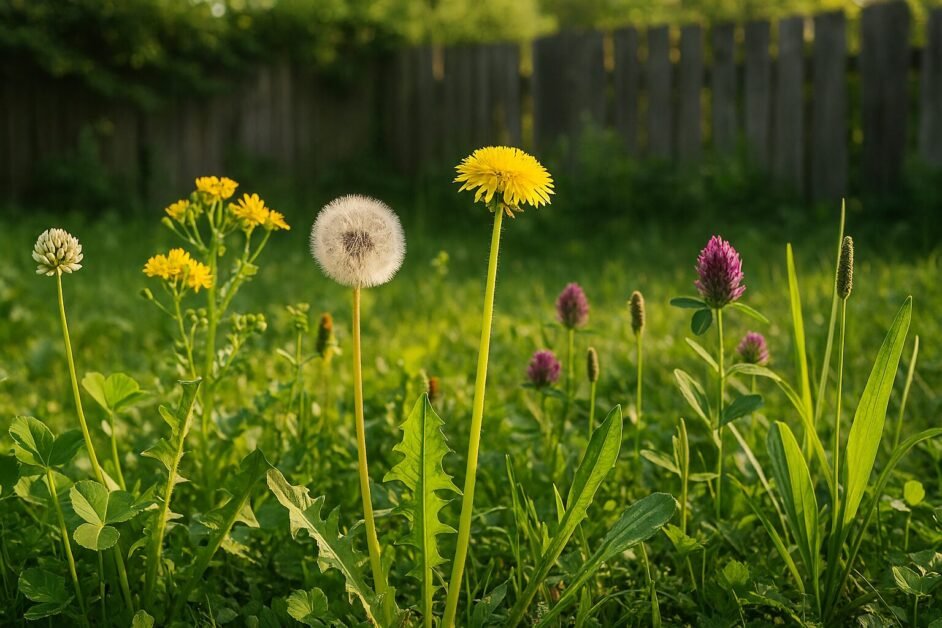
1. Dandelion (Taraxacum officinale)
You know this plant as the bane of the perfect lawn, but herbalists know it as a master detoxifier. The West Virginia University Extension highlights that dandelions have been used since Roman times for their medicinal properties.
Identification: Look for the signature bright yellow flower head composed of many tiny petals, a hollow milky stem, and jagged, lance-shaped leaves that point back toward the center. The plant grows from a deep, thick taproot.
Key Benefits: The entire plant is edible and medicinal. The roots are often used to support liver health and digestion, while the leaves act as a gentle diuretic (helping the body eliminate excess water).
How to Use:
Roots: Roast them to make a rich, coffee-like tea.
Leaves: Add young leaves to salads for a bitter digestive aid, similar to arugula.
Flowers: Infuse into oil to make a soothing salve for sore muscles.
2. Broadleaf Plantain (Plantago major)
Often found thriving in the compacted soil of driveways and walking paths, Broadleaf Plantain is widely regarded as “Nature’s Band-Aid.” It is incredibly resilient and often one of the first plants to appear in disturbed soil, and is one of the good medicinal garden weeds.
Identification: Look for a low-growing rosette of broad, oval-shaped leaves. The key identifier is the distinct parallel veins that run along the back of the leaf—if you break a stem, these veins often look like stringy celery fibers.
Key Benefits: This plant is famous for its “drawing” ability. It pulls toxins out of bug bites and stings and speeds up wound healing. According to the WVU Extension Weed Science Specialist, it also possesses anti-inflammatory and antimicrobial attributes.
How to Use:
Spit Poultice: For an immediate remedy while gardening, chew a clean leaf to release the juices and place the mash directly on a bee sting or mosquito bite.
Salve: Infuse dried leaves into olive oil to create a general-purpose healing ointment for cuts and scrapes.
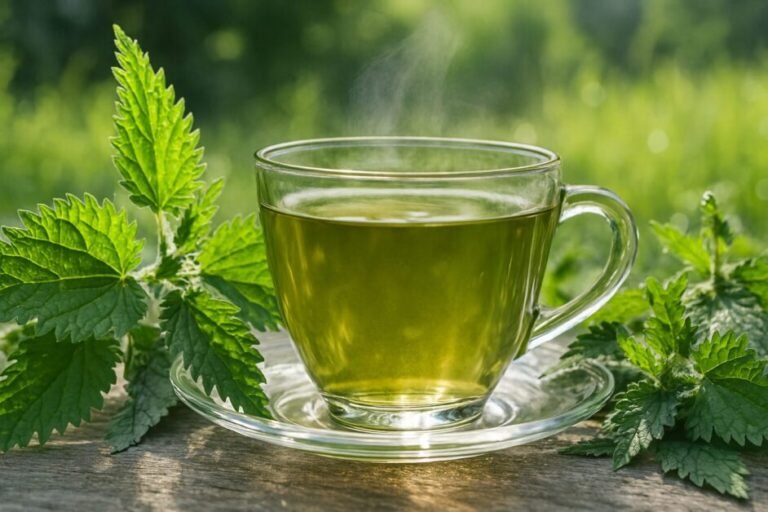
3. Stinging Nettle (Urtica dioica)
This plant demands respect. While the sting is painful, the rewards are worth it. Stinging Nettle is one of the most nutrient-dense plants you can find, packed with vitamins A, C, and K, as well as iron and calcium.
Identification: Nettle grows in dense patches and has square stems with opposite, serrated leaves. The stems and leaves are covered in tiny, hair-like trichomes that inject histamine when touched (causing the sting).
Key Benefits: Beyond its nutritional value, nettle is a powerhouse for allergy relief. The University of Rochester Medical Center notes that nettle is traditionally used to treat hay fever (allergic rhinitis) and joint pain.
How to Use:
Tea: Dried nettle leaves make a deeply nourishing, earthy tea that is excellent for allergy season.
Cooking: Treat it like spinach. Once boiled or steamed, the stinging hairs are neutralized. It makes a delicious substitute for cooked greens in lasagna or soup.
4. Common Chickweed (Stellaria media)
Often appearing in the cooler months of spring and fall, Chickweed is a delicate, sprawling ground cover that many gardeners yank out to clear space for vegetables. But in reality, it is one of the best of the common medicinal garden weeds.
Identification: Look for small, egg-shaped leaves growing in opposite pairs along a tender stem. The defining feature is the tiny white flower, which looks like a star (Stella means star). If you look closely at the petals, they are deeply cleft, making five petals look like ten.
Key Benefits: This plant is renowned for its cooling and soothing properties, particularly for the skin. It is often used to relieve itching caused by eczema, insect bites, or rashes. The University of Wisconsin Horticulture Division notes its prevalence in cool, moist, nitrogen-rich soils—often the sign of a fertile garden!
How to Use:
Salve: Infuse dried chickweed into oil to make a “green salve” for itchy, dry skin.
Fresh: It has a mild, corn-silk flavor. Eat it fresh in salads to preserve its high vitamin C content, as cooking can diminish its nutritional value.
5. Purslane (Portulaca oleracea)
If you have a crack in your sidewalk or a dry, sunny patch in your garden, you likely have Purslane. While it looks like a thick-leaved succulent, it is actually a nutritional heavy hitter.
Identification: Purslane grows low to the ground like a mat. It has smooth, reddish stems and fleshy, paddle-shaped green leaves. It produces tiny yellow flowers. Caution: It can be confused with Spurge, which is toxic. Break the stem—Spurge has milky white sap; Purslane has clear, watery juice.
Key Benefits: Purslane is a superfood disguised as a weed. It contains more Omega-3 fatty acids than any other leafy vegetable plant. It is also rich in antioxidants and magnesium.
How to Use:
Culinary: The leaves are crunchy with a slightly sour, lemony taste. They make a great addition to salads or can be pickled for winter storage.
Thickener: Like okra, it has a mucilaginous quality that can help thicken soups and stews naturally.
6. Red Clover (Trifolium pratense)
You’ve likely seen this pink-purple flower popping up in lawns and pastures. While it fixes nitrogen in the soil (helping your grass grow), it also fixes issues in the body.
Identification: A legume with the classic “three-leaf” clover pattern. The leaflets often have a white V-shaped watermark (chevron) on them. The flower heads are round, pink to purple, and composed of many tiny tubular flowers.
Key Benefits: Red Clover is a rich source of isoflavones (water-soluble chemicals that act like estrogens). Mount Sinai Health Library indicates that it is traditionally used to treat symptoms of menopause, such as hot flashes, and may help maintain bone density.
How to Use:
Tea: The flowers are sweet and mild. Dry them for use in tea blends aimed at hormonal balance.
Tincture: Often used in herbal preparations for blood purification and skin conditions like psoriasis.
7. Cleavers / Bedstraw (Galium aparine)
If you have ever walked through tall grass and found green stems sticking to your pant legs, you’ve met Cleavers (also affectionately known as “Sticky Willy”).
Identification: Cleavers have long, square stems that are weak and tend to sprawl or climb over other plants. The leaves grow in whorls (circles) around the stem. The entire plant is covered in tiny, hooked hairs that act like Velcro.
Key Benefits: Herbalists prize Cleavers as a lymphatic tonic. It is traditionally used to “cleanse” the system and support urinary tract health. According to North Carolina State University Extension, it is a winter annual that thrives in moist, shady areas.
How to Use:
Cold Infusion: Unlike most herbs, Cleavers is best prepared in cold water. Chop the fresh herb, soak it in cool water overnight, and drink it as a refreshing spring tonic.
Juice: The fresh juice is potent but can be bitter; mix it with other juices.
8. Yarrow (Achillea millefolium)
Yarrow is a legendary herb, named after the Greek hero Achilles, who reportedly used it to stanch the bleeding of his soldiers’ wounds.
Identification: Yarrow has feathery, fern-like leaves that look delicate but are tough. The flower heads are flat-topped clusters of tiny white (or sometimes pink) flowers. Caution: It can look similar to toxic members of the carrot family (like Poison Hemlock), but Yarrow does not have smooth stems (they are fuzzy) and smells aromatic, not musty.
Key Benefits: Yarrow is a “styptic,” meaning it stops bleeding rapidly. It is also a “diaphoretic,” used to induce sweating to help break a fever. This is a rugged perennial that is deer-resistant and attracts beneficial pollinators.
How to Use:
Powder: Dry the leaves and flowers and grind them into a powder to pack onto minor cuts and scrapes.
Tea: Hot yarrow tea is a classic remedy for early stages of colds and fevers.
9. Purple Dead Nettle (Lamium purpureum)
Often confused with Henbit, Purple Dead Nettle is one of the first splashes of color in the early spring garden.
Identification: It has square stems (it’s in the mint family) and triangular, fuzzy leaves that fade from green to purple at the top. It produces small, tubular pink/purple flowers. Unlike “Stinging Nettle,” this plant is “dead,” meaning it has no sting.
Key Benefits: This plant is often used for allergy relief because it grows naturally right before the spring allergy season peaks—nature’s timing is perfect. It is anti-inflammatory and anti-fungal. Purdue University identifies it as a common winter annual that thrives in nutrient-rich soils.
How to Use:
Tea: The leaves can be used fresh or dried for a mild, grassy tea.
Salve: Infuse into oil to create a rub for sore muscles or inflamed skin.
10. Wild Violet (Viola sororia)
These cheerful purple flowers are a staple of many lawns, much to the dismay of those seeking a “golf course” look.
Identification: Violets have heart-shaped leaves and distinctive 5-petaled purple (or sometimes white/yellow) flowers.
Key Benefits: Both the leaves and flowers are edible. The leaves are high in Vitamin C and A. Historically, violets have been used to soothe dry coughs and support the lymphatic system. These are a persistent perennial that spreads via rhizomes.
How to Use:
Syrup: Violet flower syrup is a beautiful, bright blue/purple treat used for coughs or as a cocktail mixer.
Salad: The flowers make a beautiful, edible garnish.
How to Harvest and Prepare Medicinal Garden Weeds
Once you have identified your plants and ensured the location is safe, the harvesting process of medicinal garden weeds is simple. However, there is an art to turning a raw plant into a remedy.
Sustainable Harvesting
Even though these plants are “weeds,” it is important to practice ethical wildcrafting. Stick to the “Rule of Thirds”: take one-third for yourself, leave one-third for the plant to regenerate, and leave one-third for the bees and local ecosystem.
Cleaning Your Harvest
Just like lettuce from the grocery store, wild greens need to be cleaned. Colorado State University Extension recommends washing fresh produce under running water to remove soil and potential bacteria. If you are harvesting roots (like Dandelion), you will need to scrub them thoroughly with a vegetable brush.
Basic Preparations
You don’t need a chemistry degree to make herbal remedies. Here are the four most common methods:
Infusion (Tea): Best for leaves and flowers (like Nettle or Red Clover). Pour boiling water over the plant material and cover it to keep the volatile oils from escaping. Steep for 10–20 minutes.
Decoction: Best for tough roots and bark (like Dandelion roots). Simmer the plant material in water on the stove for 20–40 minutes to extract the medicinal compounds.
Poultice: The simplest first-aid method. Mash up fresh plant material (like Plantain) to release the juices and apply it directly to the skin. You can hold it in place with a bandage.
Salve: A semi-solid ointment used for skin irritations. This involves infusing the herb into a carrier oil (like olive oil) for several weeks, then melting beeswax into the oil to thicken it.
Common Medicinal Garden Weeds Conclusion
Gardening is often a battle for control—us versus the wild. But when we shift our perspective, the battleground turns into a pantry. The dandelions you once poisoned become a liver tonic; the plantain in your driveway becomes a first-aid kit.
By embracing these common medicinal garden weeds, you not only reduce your reliance on chemical herbicides but also gain access to sustainable, free, and potent natural remedies.
Start small. This week, try to identify just one of the plants on this list. Observe where it grows, double-check its features, and perhaps, harvest a small amount for a cup of tea. You might find that the best medicine isn’t at the pharmacy, but right under your feet.
Frequently Asked Questions (FAQ)
Q: How do I preserve these weeds for winter?
A: Drying is the easiest method. Bundlie herbs and hanging them upside down in a dark, warm, and well-ventilated area, or using a dehydrator on a low setting.
Q: Can I harvest weeds from a lawn treated with "Weed and Feed"?
A: No. You should never consume plants from a lawn treated with synthetic fertilizers or herbicides. These chemicals are not meant for human consumption and can persist in the plant tissues.
Q: What is the best time of day to harvest?
A: Ideally, harvest in the morning after the dew has evaporated but before the hot midday sun hits the plants. This is when the plant's essential oils are often most concentrated.